St Mark’s Hospital Foundation is dedicated to funding medical research that looks to understand the root causes, progression, and response to treatment of a wide array of complex bowel diseases.
We support research that seeks to determine what combination of genetics, faulty biological mechanisms, and environmental factors cause people to develop bowel diseases in order to halt disease progression and develop targeted and effective treatments.
Boomers vs Millennials: How changes in the exposome contribute to early-onset colorectal cancer
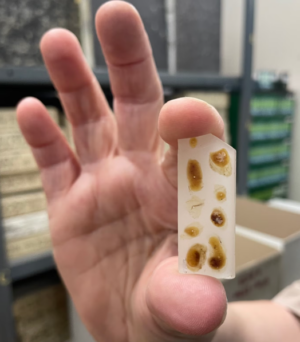
Over the last 40 years, the number of bowel cancer cases in individuals under 50 years old has been increasing considerably. In response to this worrying trend, St Mark’s Consultant Gastroenterologist, Professor Kevin Monahan, has partnered with Professor Trevor Graham from the Institute of Cancer Research to understand why.
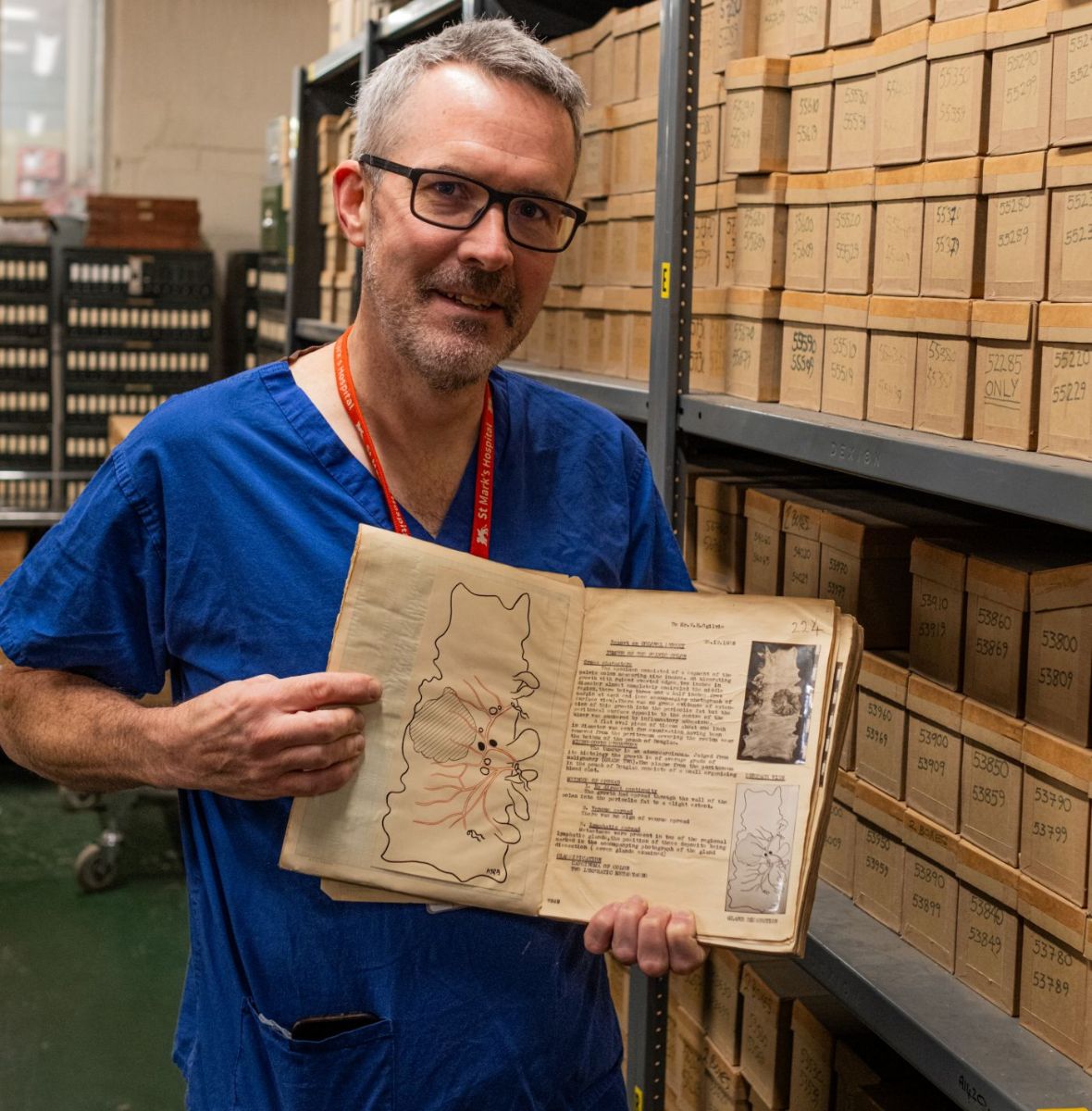
Critical to the ‘Boomers vs Millennials’ research are archived St Mark’s tumour specimens dating back to the 1950s, which represent one of the largest and oldest collections of bowel cancer pathology specimens in the world.
By comparing decades-old tumour samples to present day cancer cases, Professors Monahan and Graham, with Dr Penelope (Pebs) Edwards as the research fellow, are looking to determine whether changes in specific environmental factors are responsible for the increase in diagnoses of colorectal cancer in younger people.
This research attracted national media attention in 2026 from several news outlets including BBC News.
Towards Improving Future Care of Perianal Fistulising Crohn’s disease
Perianal fistulising Crohn’s disease (PFCD) is a particularly challenging and debilitating manifestation of Inflammatory Bowel Disease. PFCD leads to the formation of fistulas—abnormal tunnels between the back passage and the skin—that can cause debilitating symptoms and often result in multiple surgeries and diminished quality of life.
Even though PFCD is a frequent complication, affecting 1 in 5 individuals with Crohn’s disease, it has historically not been well studied. Patients with this condition have often not been included in research trials in sufficient numbers to draw meaningful conclusions.
St Mark’s Hospital Foundation is proud to support the work of research fellow, Dr Eathar Shakweh, from the St Mark’s Fistula Research Unit which is working with Imperial College London and various international partners to bring together the largest cohort of patients with PFCD ever assembled.
Data collected from these patients has already led to promising results as researchers have been able to use tissue samples to measure chemical signals within fistulas. This exciting work aims to determine why and how PFCD arises and identify a set of biomarkers or ‘predictors’ of treatment response to better support patients.
Understanding the cancer risk of serrated lesions in Inflammatory Bowel Disease
Sessile serrated lesions—damaged or abnormal tissue named for its serrated, saw-like appearance—are increasingly being detected in patients with Inflammatory Bowel Disease and have been identified as a precursor to bowel cancer.
Furthermore, improved endoscopic technology has helped identify additional types of abnormal, serrated bowel tissue, such as serrated epithelial change. Serrated epithelial change refers to the presence of microscopic saw-like lesions in the mucosa, or inner lining of the bowel, that cannot be seen by the naked eye. Serrated epithelial change is being increasingly recognised at St Mark’s during Inflammatory Bowel Disease surveillance colonoscopies; however, its relation to bowel cancer is not fully understood.
Miss Sara Renshaw is a Clinical Academic Fellow at St Mark’s. Through molecular analysis, her research seeks to understand serrated lesions within Inflammatory Bowel Disease, define their cancer risk, and identify markers that can predict which patients are at higher risk of developing cancer.