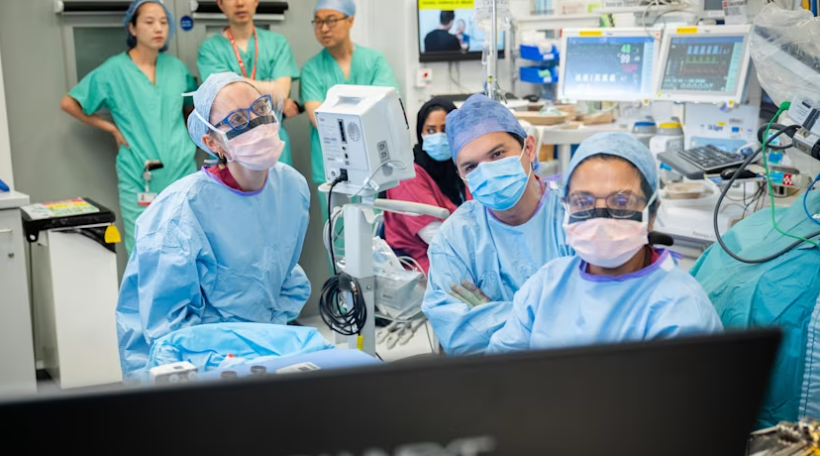
Surgeons at St Mark’s Hospital have become one of the first medical teams in the UK to use a new artificial intelligence system that colour codes internal anatomy during live surgery.
The technology, known as the Eureka system, analyses the surgical field in real time and overlays colours onto structures such as nerves, connective tissue, and other critical anatomical features. By doing so, it aims to enhance precision, reduce the risk of accidental injury, and support surgeons during complex procedures.
The system was used for the first time this month by St Mark’s Consultant Surgeon and Director for Innovation, Mr Kapil Sahnan, during a bowel resection on a woman in her 60s with Inflammatory Bowel Disease.
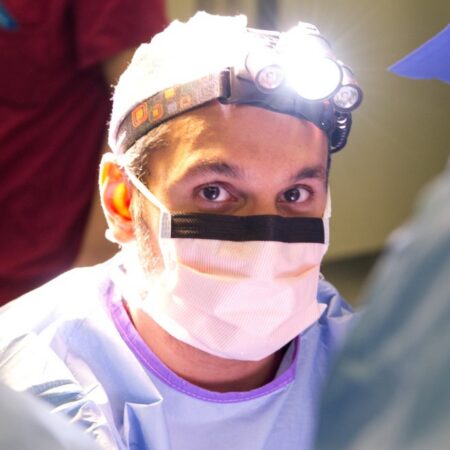
“You have this kind of extra helping arm with artificial intelligence running at the same time as your surgery, preventing errors and making everything a lot more safe. And we were the first hospital in the world outside of Japan to use it.”
– Mr Kapil Sahnan
A New Layer of Surgical Vision
Developed by a team of surgeons in Japan, the Eureka system has been trained on thousands of annotated surgical videos. This allows the AI to recognise subtle structures that may be difficult to distinguish with the naked eye—especially in minimally invasive or robotic procedures. The system was officially launched in the UK at the 10th Portsmouth Colorectal Congress, where Professor Jim Khan used the technology during live robotic surgery.
During the operation, the system projected colour overlays onto the live surgical feed. For example, nerves might appear in green, connective tissue in turquoise, and other structures in distinct hues. Surgeons could choose to keep the overlay constant or have it pulse intermittently depending on the stage of the procedure.
A Step Toward Safer, Smarter Surgery
The introduction of real time AI guidance marks a significant shift in how surgeons may navigate anatomy in the future and showcases St Mark’s position as a world leader in colorectal surgery.
Mr Sahnan compared the leap to the transition from paper road atlases to modern digital navigation apps—an evolution from static reference to dynamic, moment by moment support. The hope is that such technology will reduce complications, shorten operating times, and improve outcomes across a wide range of procedures. Early use suggests the system can identify structures faster than the human eye, offering a safety net during intricate dissections.
Looking Ahead
St Mark’s Hospital is working with partners to develop more uses for the device and evaluate the system’s impact. While still in its early stages, the technology has the potential to become a standard tool in operating theatres worldwide.
If adopted at scale, AI assisted visualisation could represent one of the most significant advances in surgical safety in decades—bringing a new level of clarity to some of the most challenging moments in modern medicine.
You can read more about this story here:
Sky News: Surgeons in UK use new tool powered by AI for first time during live operation
The Standard: New AI tool which colour-codes the body during live surgery used in UK-first
Channel 4: New AI tool which colour-codes the body during live surgery used for first time in UK
St Mark’s Hospital Foundation is proud to support groundbreaking innovation at St Mark’s Hospital. Help us make even more advances in gastroenterology and colorectal surgery possible by donating today.