As the name Inflammatory Bowel Disease suggests, Crohn’s disease and ulcerative colitis are predominantly defined by their gastrointestinal symptoms. However, IBD can also have a significant impact on other areas of the body.
Fatigue, characterised by extreme tiredness that does not go away with rest, is a common and debilitating symptom of IBD outside of the gut. Even in remission, when inflammation is well controlled, fatigue can have a serious impact on individuals’ mental health and quality of life. During a flare, 70% of patients with Crohn’s or colitis report experiencing fatigue, while 40% experience fatigue while in remission.
 Dr Yaa Danso is an IBD clinical research fellow at St Mark’s Hospital under the supervision of Consultant Liaison Psychiatrist, Dr Calum Moulton, and Consultant Gastroenterologist, Professor Ailsa Hart. Dr Danso’s research explores the benefits of psychological and psychotropic treatment options for patients in order to find the best way to address the wider symptoms of IBD.
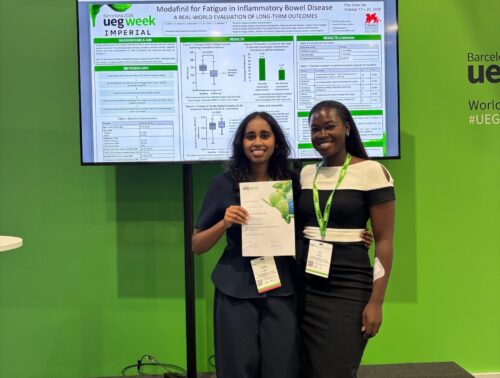
During her time at St Mark’s, Dr Danso has conducted the first ever feasibility study evaluating the use of Modafinil in patients with IBD. Modafinil, a stimulant drug traditionally used to treat narcolepsy, was prescribed to 76 IBD patients with severe, persistent fatigue. Over a follow-up period of 25 months, 67.9% of patients experienced a clinically meaningful improvement in fatigue.
As it continues to progress, we are delighted to see this work recognised on an international stage at United European Gastroenterology Week 2026. The Modafinil feasibility study’s success is expected to enable the development of larger clinical trials in the future and could make a meaningful difference for IBD patients’ overall health and quality of life.
In honour of Crohn’s and Colitis Awareness Week, Dr Danso sat down with the Foundation to share more about her journey into medicine and her motivation to pursue this important research.
Q: Can you tell us a bit about your background, what inspired you to pursue medicine, and how you ended up at St Mark’s?
I grew up in east London. I am the youngest of 3 siblings, my older sister is a doctor and she is the first medic in my family on both sides. My parents were raised in the outskirts of Ghana and had really humble beginnings. My family, my mum especially, really instilled in me the importance of hard work, commitment and to play the long game. When I realised I had the clinical acumen, and I found a genuine joy when meeting new people and finding out more about them, becoming a doctor seemed like a good match for me.
I feel the most formative years of my career have actually come since I’ve become a doctor. I completed my medical training at Barts in London and completed the early part of my career in Manchester. In Manchester, I met a great professor in IBD. I still remember his stories and how he brought in patients and helped us learn. From then on, I knew I wanted to work in the field of IBD.
I eventually moved back to London to be closer to my family, and I took time out of training to work in a tertiary IBD centre where I recruited and managed patients on IBD clinical trials. This gave me direct access to research, and showed me things that were possible with my medical degree that I hadn’t thought about before. Again, I met some fantastic mentors who gave me the confidence to take what I enjoyed in IBD one step further. This has allowed me to pursue an IBD PhD here at St Mark’s, and I’m so happy to be here.
This has been one of the most enjoyable few years of my career. I love the fact I get to see patients over and over again, something that wasn’t possible when I was at places for shorter times. I have a fantastic group of supervisors who I admire and also learn from. I have so much more to give, and I feel that being at St Mark’s has given me the confidence and a stepping stone to really achieve my full potential.
Q: Can you give a brief overview of the research you’re working on?
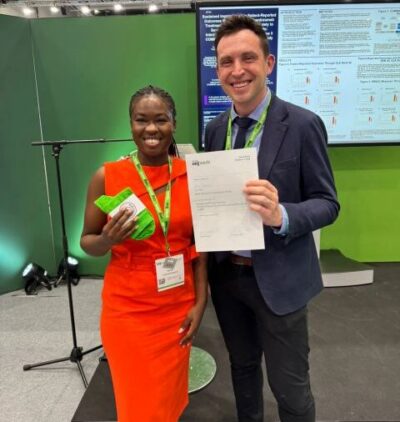
My research is looking at fatigue in IBD. Specifically, I’m looking at predictors of fatigue. I am trying to understand what types of risk factors patients with IBD could have that makes them at risk of fatigue, and also looking at what groups of patients or disease characteristics would have most benefit from treatment.
My research also looks at a novel drug therapy, modafinil, which is currently licensed for the use in narcolepsy, and we used this off-label in a small group of IBD patients at St Mark’s and had a great effect. The data was promising at one year. We are now doing a feasibility larger trial with four hospitals to see if there remains a good effect.
Q: What excites you most about your research and what motivates you to pursue it?
Fatigue can be incredibly stigmatising for patients. Patients often self-blame a lot, using words like “I’m lazy” or “I just need to get my act together.” By showing that I’m researching this and asking patients about it, I want to shift the responsibility to the medical team to try and improve this symptom rather than patients feeling that they are responsible for the symptoms of their IBD. Successful fatigue treatment is something that can have a substantial impact on so many people’s lives. Speaking to patients in clinic, I recognise how debilitating fatigue can be. Through these conversations, I see how important quality of life is. I want to help patients live to do what they choose to do rather than being restricted or controlled by a chronic illness.
From a professional aspect, I’m encouraged to share this work and knowledge with the academic circles in the UK, Europe, and beyond. I think seeing our work motivates others to try and tackle this difficult topic and realise that this is something that we need to start looking into as soon as possible. Although it’s great having my knowledge shared in academic circles, what excites me most is the potential for my research to eventually find the clinicians and patients who don’t come to conferences and who don’t read journals.
On a personal level, I’m a Black, female Gastroenterologist. As soon as I walk into a room, I am in a minority within my field. Within my career, this difference has been very palpable and has shaped feelings of insecurity and imposter syndrome. I really believe in the statement of “you can be what you see.” I want another young girl, like me, to see that, not only is there a place for them in research, but research needs them. I want to be the person for them that some of my consultants and mentors were for me.
Q: Is there anything you would like to say to St Mark’s patients and supporters for Crohn’s and Colitis Awareness Week?
Share your story. Ask each other questions that you wish someone asked you. And tell your healthcare professional about your personal achievements and goals. Healthcare professionals want to hear it. We care about you, not just your inflammatory markers.