Research and education at St Mark’s Hospital are central to improving clinical care and outcomes for patients with complex, and rare, bowel diseases. Thanks to our generous supporters, St Mark’s Hospital Foundation is able to fund the cost of around 30 research fellows every year. These fellows represent the future of not only St Mark’s, but gastroenterology and colorectal surgery worldwide.
Every year at St Mark’s Academic Institute’s flagship conference, Frontiers in Colorectal and Intestinal Disease, one research fellow is awarded the John Nicholls Prize for Research. The prize, presented by the prestigious surgeon and creator of the J Pouch, Professor John Nicholls himself, goes to the individual whose work best illustrates the ground-breaking research done by St Mark’s research fellows.
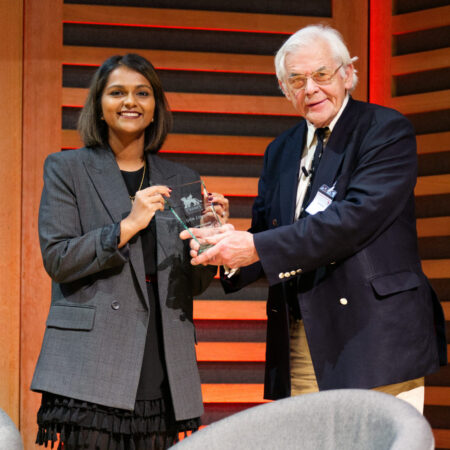
The 2025 winner, Dr Gita Lingam, sat down with the Foundation to discuss her research, her experience as a fellow at St Mark’s Hospital, and her thoughts on the impact of artificial intelligence in the field of gastroenterology and colorectal surgery.
Q: Can you give a brief overview of your research?
A: My research focuses primarily on using artificial intelligence to improve the management of Crohn’s disease. Unfortunately, Crohn’s disease is a lifelong incurable disease, with patients having frequent hospital attendances and often multiple surgeries. My research aims to explore why recurrence rate is so high in Crohn’s disease and if AI can help to improve this.
One of my main projects is looking at how we assess post-operative recurrence endoscopically. Currently many patients will have a colonoscopy following their operation to assess if their disease has returned. This requires highly specialised endoscopists being able to accurately evaluate endoscopic images. From the work we’ve done so far, we know that AI has a role to help endoscopists detect recurrence.
So far, we’ve been focused on data collection, endoscopic image analysis, and collaborative work with international partners to refine methodology and develop robust research outputs. Moving forward, the aim is to translate this into clinically meaningful tools and systems that can support endoscopists in detecting early recurrence.
Q: What excites you most about your research?
A: What excites me most about this research is the opportunity to bridge every day clinical practice with digital innovation. In IBD especially, where disease behaviour is heterogeneous and recurrence is common, smarter surveillance strategies could have a real impact on patient outcomes and ultimately their quality of life.
Q: How does AI fit into the world of gastroenterology and colorectal surgery?
A: AI is already beginning to reshape gastroenterology and colorectal surgery. In endoscopy, we are seeing real-time polyp detection and characterisation. In IBD, AI models are being developed to predict flare-ups, stratify risk, and standardise scoring systems. In surgery, data science may soon inform intraoperative decision-making, complication prediction, and long-term outcomes analysis. The key challenge lies in ensuring these tools are clinically relevant, rigorously validated, and thoughtfully implemented.
Q: What inspired you to take on this research? What interests you about the topics you are focusing on?
A: I was drawn to this field for two main reasons. The first being an interest in the expansion of surgical innovation and how we can use AI to solve real clinical problems. The second is a feeling that sadly Crohn’s patients are often overlooked. Typically, patients are diagnosed at an early age and thus suffer for many years. Even a small improvement in management could potentially have a profound effect on quality of life for Crohn’s patients.
Q: Can you tell me about your experience with St Mark’s? What has been unique about it?
A: Over the past two years, I’ve had the privilege of working as a Research Fellow at St Mark’s Hospital under the supervision of Mr Kapil Sahnan. This post was my first experience of research within surgery and has been an incredible learning opportunity.
My experience at St Mark’s has been exceptional. The hospital’s history creates an environment where research is embedded into daily practice. What makes it unique is the culture there is a genuine openness to collaboration, academic discussion, and innovation. Working alongside clinicians and researchers who are leaders in their fields has been both inspiring and humbling.
This experience has reinforced for me that the future of colorectal surgery will not be defined by technology alone, but by how we integrate technology with thoughtful clinical care. I’m excited to see where the next phase of this work leads.