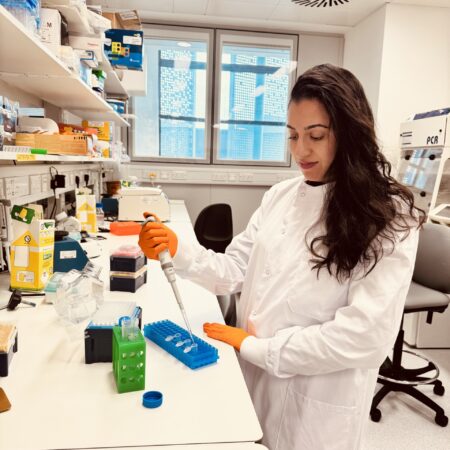
 Diya Kapila is the newest clinical research fellow at St Mark’s Hospital pursuing a PhD funded by 40tude Curing Colon Cancer. Taking over the ICAN research project, a collaboration between St Mark’s and the Institute of Cancer Research, Diya is looking to develop less-invasive ways to accurately predict cancer risk in patients with Inflammatory Bowel Disease.
After starting in her role early last month, Diya sat down with us at the Foundation to discuss her clinical background and thoughts on moving the ICAN project forward.
Q: Can you tell us a bit about your background and how you ended up at St Mark’s?
I am currently undertaking a PhD under the supervision of Professor Ailsa Hart and Dr James Alexander at St Mark’s, and Professor Trevor Graham at the Institute of Cancer Research. My research focuses on dysplasia in inflammatory bowel disease, with the goal of improving prediction of cancer risk and optimising surveillance to enhance patient outcomes.
I first developed an interest in digestive diseases during medical school at Imperial College London, and over the course of my training this evolved into a particular focus on inflammatory bowel disease.
St Mark’s has long been recognised as a centre of excellence in bowel disease care and research, and it is a genuine privilege to be part of the team. The depth of specialist expertise here is unlike anywhere else, and the opportunity to combine clinical work with meaningful research made it the ideal next step in my Gastroenterology training.
Q: What inspired you to pursue medicine and how have your life experiences shaped the kind of clinician you have become?
Much of what has shaped me has been the people I work with and the patients I care for. For me, being a good clinician isn’t just about knowledge – it’s about seeing your patients as whole people and advocating for voices that aren’t always heard. Shared decision-making is central to good care, and it’s often in the moments when patients are facing the most difficult decisions that you see how good communication and teamwork can truly make a difference.
I feel very fortunate to work alongside a fantastic multidisciplinary team with exceptional and inspiring supervisors.
Q: Can you give a brief overview of the research you’ll be working on? How does it feel taking over such a longstanding project?
People living with IBD affecting their large bowel have around twice the risk of developing colorectal cancer, so many patients enter long-term colonoscopy surveillance programmes. The challenge is accurately identifying who is truly at highest risk – because the decisions that follow, whether intensive surveillance or major surgery, are life-changing.
The research builds on work by Professor Trevor Graham and his team, who have identified a genomic marker measuring DNA copy number changes that appears highly accurate in predicting cancer risk. The exciting next step is exploring whether this could be detected through less invasive methods – like blood or stool tests – making surveillance more personalised for patients in the future.
There’s real momentum behind this work. It’s the result of years of dedication from researchers, clinicians, and patients across St Mark’s and the Institute of Cancer Research. I feel a real sense of gratitude to everyone who has contributed to getting us to this point, and a genuine excitement about what we can achieve from here.
Q: What excites you most about your research at St Mark’s? What are you most looking forward to?
What excites me most is the translational potential – the ability to ask a research question and see it shape real clinical practice for patients. The questions we ask in research come directly from patients’ experiences, which makes the work feel meaningful and relevant.
The collaborative culture within the multidisciplinary team at St Mark’s feels different. There’s a shared purpose here that I find really energising.
Q: Is there anything you would like to say to St Mark’s patients and supporters for Bowel Cancer Awareness Month?
I want to start by saying thank you to every patient who has been part of research here, who has trusted us with their experiences, and who has kept coming back even when things have been hard. Your contribution helps us continue improving care for future patients – none of this progress would be possible without you.
Bowel Cancer Awareness Month is a really important reminder of the value of early diagnosis and open conversations about bowel health. For anyone out there who has noticed a change in their bowel habits, seen blood, or has a family history they’re worried about, please speak to someone. Early action really does make all the difference.